ubsurface power distribution networks operate under constant exposure to moisture, hydrostatic pressure, and seasonal groundwater table fluctuations. In medium- and high-voltage cable assemblies where voltage stress control and moisture barriers are simultaneously required, specifying a semi conductive water blocking tape is essential to halt axial fluid propagation while maintaining equipotential contact.
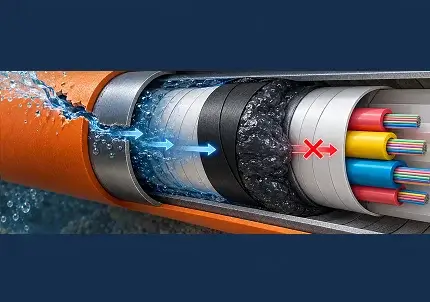
Should localized mechanical damage puncture a cable’s outer jacket, this swelling tape substrate expands into a dense gel matrix upon fluid contact, preserving internal insulation integrity. While non-conductive variants suit low-voltage lines and fiber optics, high-field power environments demand this specialized semi-conductive performance to eliminate internal voltage differentials and prevent partial discharge.
Understanding the electrical and swelling mechanisms
When fresh or salt water touches superabsorbent polymer (SAP) fibers, a cross-linking reaction triggers swelling within seconds. In power cable construction, these SAP elements are combined with woven or non-woven polyester matrices to deliver specific mechanical and electrical properties.
+-------------------------------------------------------------------------+
|                  HIGH-VOLTAGE CABLE INTERIOR CROSS-SECTION               |
|                                                                         |
|   [ Conductor ] --> [ Semi-Conductor ] --> [ XLPE Insulation ]          |
|                                                                         |
|   --> [ Semi-Conductive Water Blocking Tape ] <--- (Gili Test Swell Zone)|
|                                                                         |
|   --> [ Metallic Shield / Screen ] --> [ Outer Polymeric Sheath ]        |
+-------------------------------------------------------------------------+
- Non conductive water blocking tapes: Formulated from high-purity non-woven polyester fabrics, these tapes offer high swell capacity and dielectric isolation. They serve as mechanical separators and moisture barriers in low-voltage distribution, telecom, and control cables where field stress control is unnecessary.
- Semi conductive water blocking tapes: Formulated with carbon black formulations, a semi conductive maintains a continuous conductive pathway across the core interface. By matching the electrical potential between the insulation shield and metallic screen, it eliminates localized partial discharges.
Technical comparison matrix
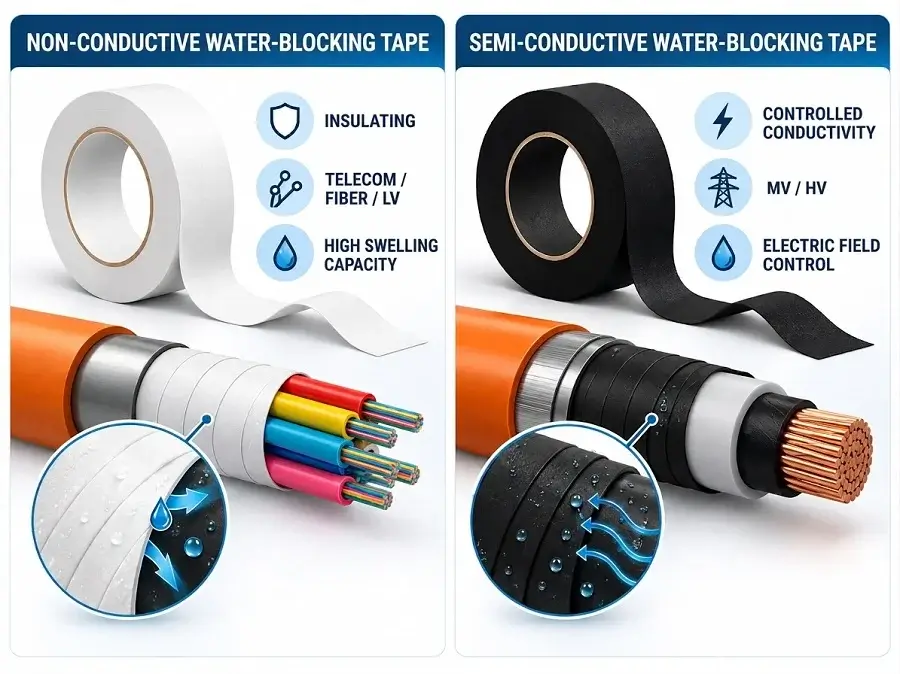
Designing cable cores according to US industry frameworks—such as guidelines published by the IEEE (Institute of Electrical and Electronics Engineers)—requires strict verification of surface resistance and swell height:
| Technical property | Non conductive water blocking tape | Semi conductive water blocking tape |
| Primary function | Moisture sealing & mechanical separation | Moisture sealing & electric field smoothing |
| Surface resistance | Insulating / Non-conductive ($\ge 10^{10}\text{ }\Omega$) | Low resistance ($\le 1500\text{ }\Omega$ via Carbon Black) |
| Volume resistance | Dielectric barrier | $< 1\times 10^6\text{ }\Omega\cdot\text{cm}$ |
| Swell speed & height | Rapid swell ($\ge 8\text{ mm}$ in 1 min) | Rapid swell ($\ge 8\text{ mm}$ to $12\text{ mm}$ in 1 min) |
| Short-term thermal limit | Up to 230 °C (Extrusion withstand) | Up to 230 °C (Extrusion withstand) |
| Target cable family | Telecom, Fiber Optic, LV Power | Medium Voltage (MV) & High Voltage (HV) Power |
Selecting the right tape for cable architectures
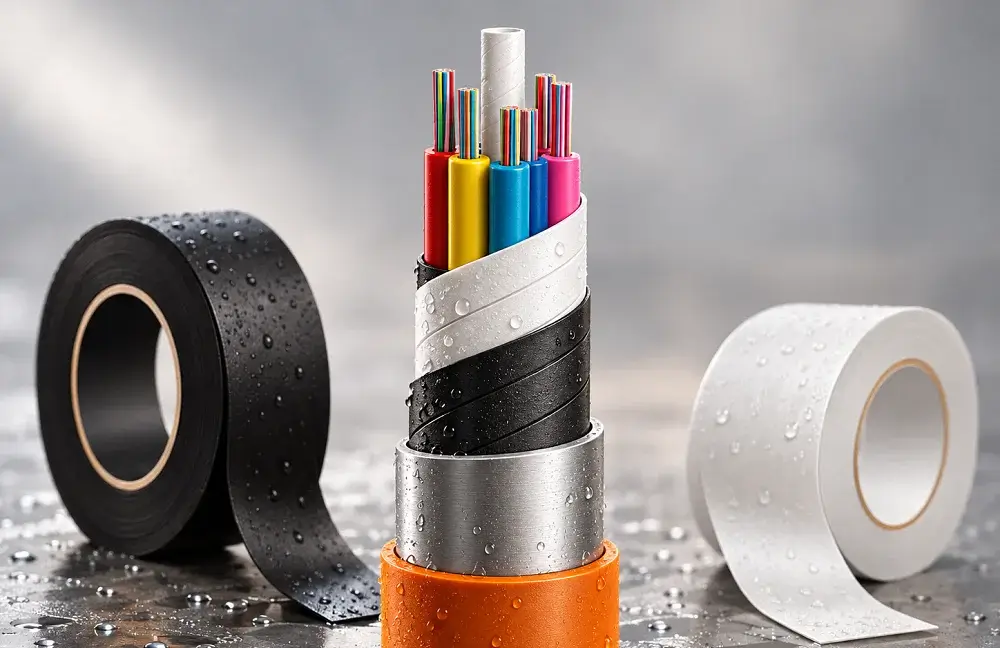
When engineering multi-core or single-core power cables, choosing between conductive and non-conductive variants dictates long-term cable reliability:
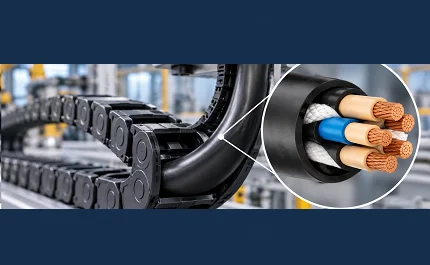
- Medium-voltage (MV) distribution cables: Applying a semi conductive water blocking tape over the XLPE insulation screen ensures smooth equipotential contact with copper wire screens or corrugated aluminum sheaths.
- High-voltage (HV) subsea cables: Submarine power links utilize a reinforced semi conductive water blocking tape under lead or aluminum sheaths to absorb hydrostatic water surges while draining capacitive charging currents.
- Dry-core fiber optic cables: Non-conductive tapes replace traditional messy gels, providing clean, swellable protection in outdoor duct cables.
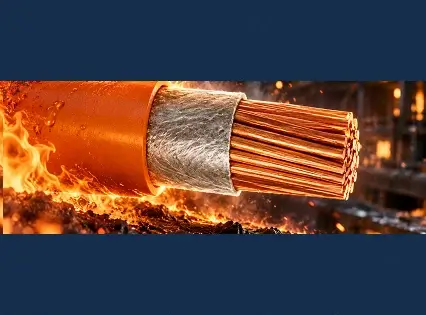
Utilizing a high-capacity semi conductive water blocking tape protects the cable assembly during temporary overload temperatures up to 230 °C without losing swell performance or conductivity.
FAQS
In medium and high-voltage cables, any air void between the insulation screen and metallic shield causes partial discharge. Semi-conductive tapes equalize electrical potential across these interfaces, preventing insulation breakdown.
Engineered water blocking tapes begin expanding immediately upon contact with moisture, reaching a swell height of at least 8 mm within 1 minute and over 12 mm within 3 minutes under standard test conditions.
No. Advanced formulation techniques integrate conductive carbon black into the non-woven matrix without encapsulating the superabsorbent polymer (SAP) fibers, maintaining high swell speed and gel stability.