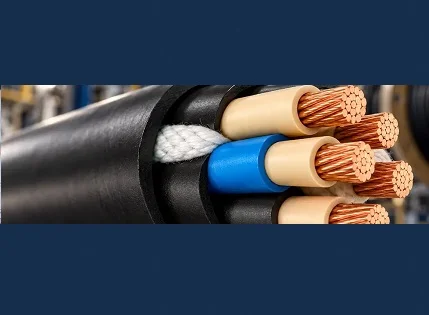
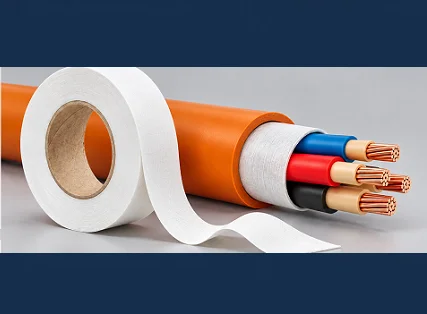
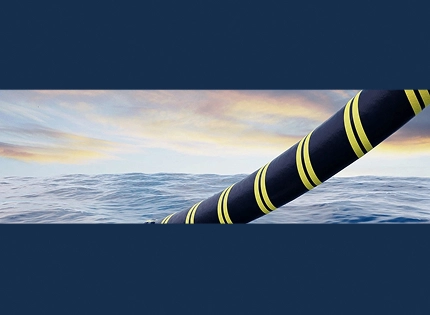
When engineers approach complex industrial cable design, they face a fundamental mechanical challenge: protecting stranded conductors from internal deformation, friction, and crush forces during continuous operation. While primary insulation provides dielectric strength and the outer jacket offers environmental protection, the internal interstitial spaces require dedicated structural stabilization.
Engineered textile components—specifically flexible cotton filler cords—play a decisive role in resolving geometric imbalances in multi-conductor cable layups.
The geometric challenge in multi-conductor layups
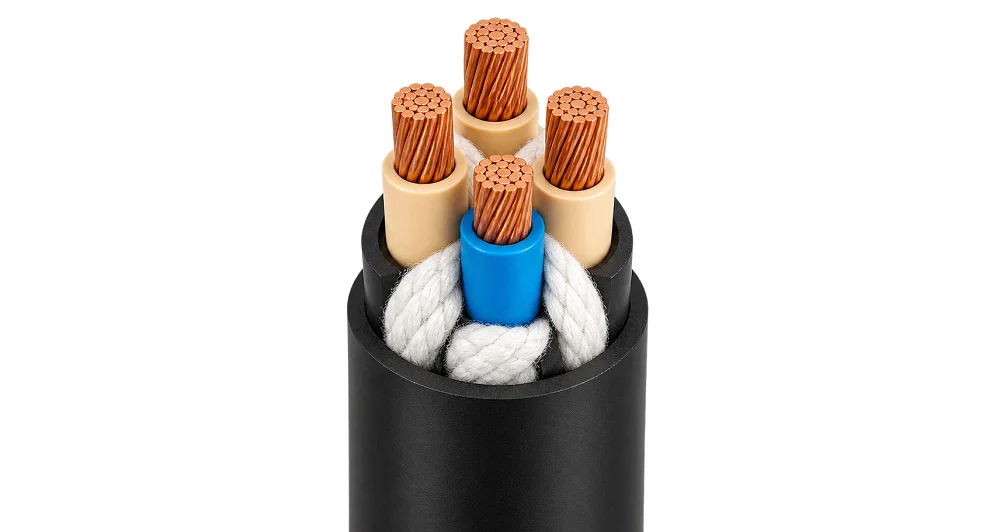
During the planetary cabling or stranding process, bundling multiple insulated conductors inherently leaves empty gaps (interstices) between cores. Following criteria from the Insulated Cable Engineers Association (ICEA), advanced industrial cable design requires filling these voids to prevent three primary mechanical failures:
- Jacket collapse during extrusion: High-pressure molten polymer forces the outer sheath into unfilled gaps, resulting in an irregular, non-concentric outer profile. This irregular wall thickness creates weak points prone to physical tearing.
- Stress concentration points: Unanchored conductors shift during repeated bending, creating localized strain points that cause insulation abrasion and core displacement.
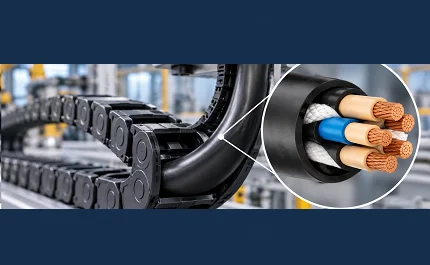
- Internal friction and heat build-up: In continuous-flex applications (such as drag chains or robotics), unguided conductor movement increases internal friction and thermal wear, shortening operating life.
Technical advantages of natural fiber structural fillers
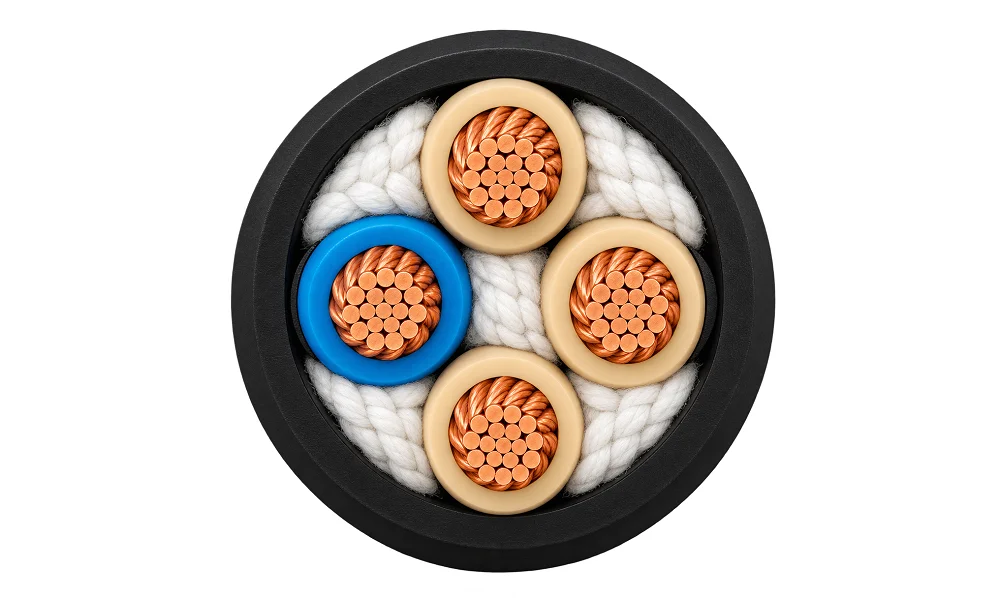
Integrating soft, high-tensile textile elements inside the cable assembly resolves these mechanical issues without compromising flexibility or adding unnecessary dead weight. In modern industrial cable design, flexible fiber fillers are precisely dimensioned to match the interstitial volume of multi-core assemblies. By conforming dynamically to tight bending radii, they distribute internal mechanical stresses evenly across the conductor bundle while delivering four critical structural advantages:
| Structural benefit | Mechanism in cable construction | Impact on performance |
| Concentric roundness | Fills interstitial voids prior to jacketing | Ensures uniform jacket wall thickness and IP-rated gland sealing |
| Shock absorption | High natural elasticity of textile fibers | Cushions compressive loads and dampens dynamic vibration |
| High tensile strength | High-purity yarn construction | Prevents cord breakage during high-speed planetary cabling |
| Thermal stability | High temperature threshold during extrusion | Resists melting or shrinking when contacting hot molten polymers |
Furthermore, natural fiber materials offer excellent compatibility with surrounding extrusion compounds. Unlike rigid plastic fillers that can create sharp internal edges under severe bend radii, soft textile yarns compress uniformly, distributing mechanical stresses evenly across the conductor bundle.
Primary applications in high-flex cable manufacturing
Engineered textile filling yarns are specified across demanding cable families where dynamic endurance, mechanical durability, and sound industrial cable design are mandatory. In continuous-flex environments, these high-tenacity yarns stabilize internal core geometry under severe torsional forces, preventing core displacement and friction-induced thermal wear over millions of bending cycles:
- Automated motion & control cables: Used in cable tracks, robotic arms, and automated assembly equipment subjected to millions of bending cycles.
- Mining & heavy-duty trailing cables: Providing internal impact absorption against severe crushing loads and surface abrasion in harsh environments.
- Elevator & hoist cables: Ensuring geometric symmetry and preventing core slippage across long vertical suspensions.
- Marine & offshore cables: Supporting internal compactness and structural integrity under high mechanical tension.
FAQS
Natural yarn fillers provide superior flexibility, compressibility, and thermal resistance. Unlike rigid extruded plastic profiles, soft cotton or textile cords conform dynamically to tight bend radii without transferring internal stress to the insulated conductors.
No. Natural fiber fillers offer an optimal strength-to-weight ratio, efficiently filling interstitial voids to achieve a circular cross-section without increasing the targeted cable outer diameter.
Yes. Juan Gili S.L. supplies custom-engineered yarns and structural cords in precise diameters, plies, and packaging formats (spools or center-pull coils) tailored for specific cabling machinery and multi-conductor configurations.