In the manufacturing of electrical cables, each component plays an essential role. While conductors and insulation are the most visible elements, there are other materials that contribute significantly to the cable’s structural performance. Among these are cotton filler cords — a technical solution that has proven crucial for enhancing the durability, stability, and flexibility of cables.
What Are cotton filler cords?
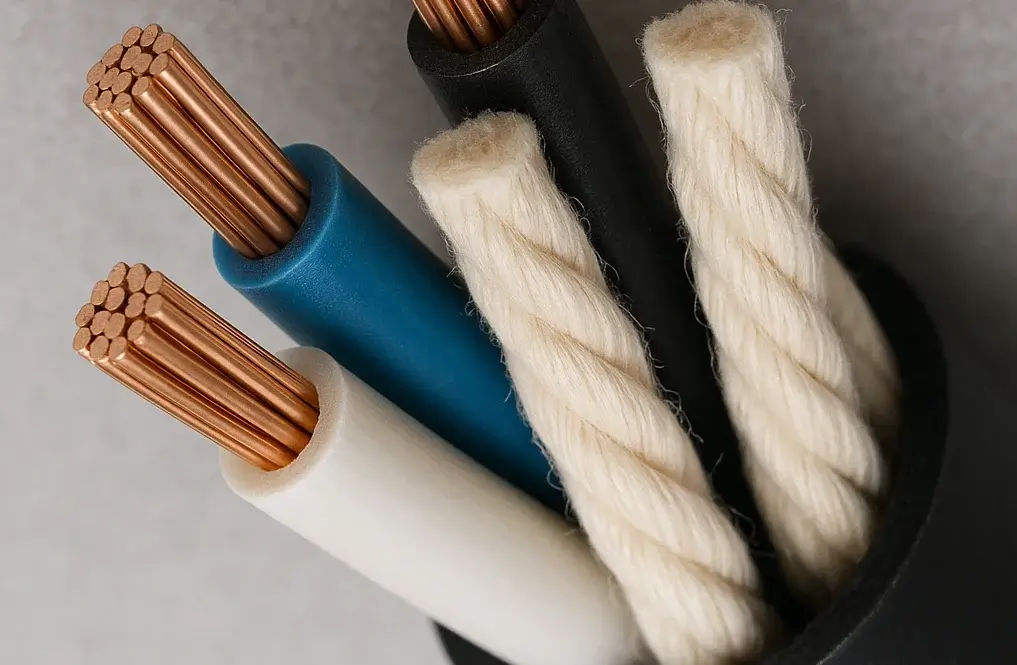
Cotton filler cords are cotton ropes specifically designed to fill the spaces between the conductors of an electrical cable. Their main function is to maintain the cable’s circular shape, prevent internal elements from shifting, and provide greater cohesion to the entire assembly during manufacturing, storage, and installation.
Made from 100% natural cotton, these cords are flexible, resistant, and adaptable to different cable diameters and configurations.
Why are they important in electrical cables?
Having a high-quality filler material is vital for the mechanical integrity of a cable. Cotton filler cords offer multiple advantages:
- More stable internal structure: They prevent conductors from moving or crossing, which could otherwise compromise electrical performance.
- Greater resistance to compression and torsion: They protect the cable during installation, especially in complex layouts.
- Compatibility with various insulation materials: They integrate well with PVC, polyethylene, rubber, and other common coatings.
- Better cable finish: They help ensure a regular, aesthetic shape, making the cable easier to handle and wind.
Typical applications
Cotton filler cords are widely used in the production of:
- Low- and medium-voltage power cables
- Industrial control cables
- Multipair or multiconductor cables
- Cables for residential and commercial installations
- Flexible and braided cables
Their versatility makes them especially useful in designs that require flexibility, tensile strength, or high dimensional stability.
Advantages over other filler materials
Although synthetic alternatives such as polyester, polyethylene, or polyamide exist, cotton remains one of the most valued materials due to its natural behavior, softness, moisture absorption, and adaptability to the cable environment. Moreover, since it is non-conductive and non-abrasive, it protects both the conductors and the insulation throughout the cable’s service life.
Technical considerations
When selecting cotton filler cords, cable manufacturers should consider factors such as:
- The appropriate diameter according to cable design
- The required twist or braiding to ensure stability
- The density and moisture absorption depending on the application
- Thermal compatibility with other materials
In practice, a well-designed filler can make a significant difference in the final cable quality, facilitating both production and field performance.
Although they often go unnoticed, cotton filler cords play a key role in the durability, flexibility, and mechanical strength of electrical cables. Thanks to their physical properties and adaptability, they are the ideal choice for reinforcing the cable’s internal structure without interfering with its technical performance.
If your company is developing high-quality cables and seeks effective, customized textile solutions, Juan Gili S.L. offers a wide range of cotton filler cords manufactured under strict technical standards. Contact us, and we’ll help you find the best option for your cable projects.